

July 21: Orientation App and Parenting College Students/Coping with the Empty Nest
Dear parents and families,
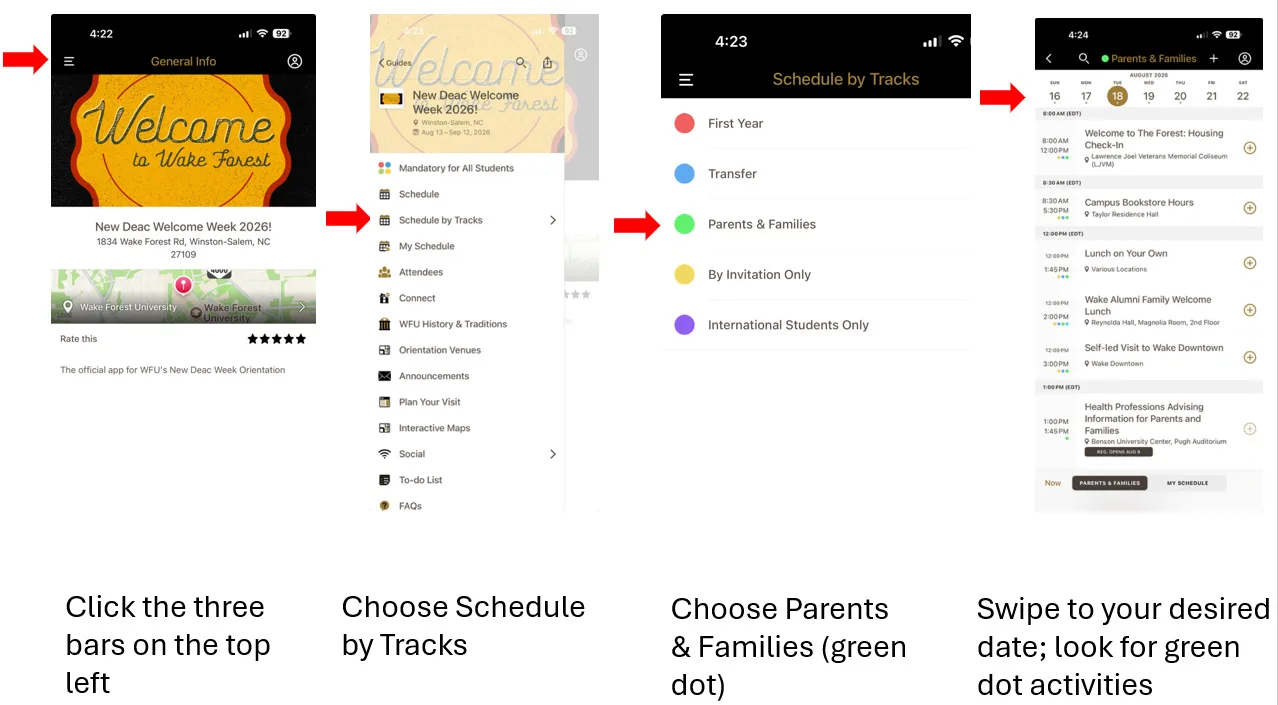
The Orientation schedule has now been published! Here is how you access it:
- DOWNLOAD THE APP: Go to your APP or Google Play Store and search “WFU Orientation Programs” to access the New Deac Welcome Week 2026 guide, or simply scan the QR code below:

- On a laptop/desktop computer or unsupported mobile device, follow this link to access the content in your web browser.
NOTE: We encourage you to download the app, as the web browser version does not support all of the features available in the mobile app version. You will find the most up-to-date information, including schedules, maps, and much more. - To see the schedule of events, do the following:
Class registration begins tomorrow for your students. Registration is an ongoing, iterative process. Your students should not expect to have their entire class schedule settled on day one. If you did not read this Daily Deac about registration expectations, please do so today so you and your ‘30 will be prepared to keep registration in perspective.
August is almost here, and with it comes a significant emotional shift. This week, we talk about ways to help both you and your student navigate their first challenges and the changing family dynamics of parenting a college student.
Action Item Tracker
- Tuition is due August 1.
- Reminder: Meet the Executive Director of CLASS (Center for Learning, Access, and Student Success) optional session will be held on Thursday, July 23 and July 30 at 6 p.m. Eastern. Register here. The session will cover learning accommodations, on-campus student success resources, tutoring and academic coaching options, and more. CLASS’ Executive Director, Dr. Michael Shuman, will review the academic accommodations process and answer questions. Join us on July 23 or July 30 at 6 p.m. Eastern.
Featured Topic: Parenting College Students
- During the K-12 school years, one of the messages families often heard was ‘parental involvement equals student success’ — families were encouraged to take an active part in their student’s education. In college, one of the goals is for students to develop independence, which means they will do most of the thinking, planning, and doing.
- While in high school, you might have been in a manager or director role with your students (where you provided directions and answers); in college, it is more helpful to adopt a consultant role (where you serve as a sounding board to prompt their thinking, but allow your students to find their own answers).
- Here are recommended parent/family roles vs. student roles. We hope this is a helpful way to think about how you can best support your students.
The “Stop, Drop, and Roll” Approach
- Once college begins, there will be a time when your student contacts you with a problem, a decision to make, a frustration, etc. When that happens, we encourage you to resist the urge to react and respond, and instead use the Stop, Drop, and Roll method to encourage your student’s reliance:
- Stop… and Take a Breath. Ask yourself: Is this situation truly something they cannot handle on their own? If you fix the issue, it prevents your Deac from gaining experience and building necessary life skills.
- Drop… the Urge to Fix It or Offer Guidance. Respond with guiding questions instead of instructions: What do you think you might do? Who on campus might have resources? What have you already tried?
- Roll… with Their Solution. Allow your student to solve the problem and execute the solution. Working through decisions and difficult situations builds their self-sufficiency.
- You can read the full Stop, Drop, and Roll method here.
- Remember: Your student is often just venting when they call with a frantic download of problems. They are not necessarily asking you to fix anything. In fact, it can be incredibly helpful if you ask them directly: What’s my role here? Am I listening and being empathetic? Are you looking for solutions? etc. — and then the hard part: do what they ask 🙂
Preparing for an Empty (or Emptier) Nest
- The first night after you leave your student at the campus and head home, you may feel a lot of strong emotions. A very wise friend gave me the best advice for the first night without your student in your house, which really helped me and my husband:
- ***Plan something fun for the evening you return home***
Avoid dwelling on the empty/emptier nest. Plan a distraction — go out to dinner or gather with friends. This simple step can turn a night of worry into an opportunity for relaxation and perspective. If you have younger children at home, include them in the fun activity; they are also experiencing the change to the family dynamic. - It is okay to feel sadness or anxiety — and it is okay to feel excitement or relief (or all of the above!) — when your student goes to college. Feel what you feel and be kind to yourself.
- ***Plan something fun for the evening you return home***
You’ll hear from me again next Tuesday!
Betsy Chapman, Ph.D. (’92, MA ’94)
Executive Director of Family Communications